F-15EX Eagle II: Advanced Air Superiority & Strike
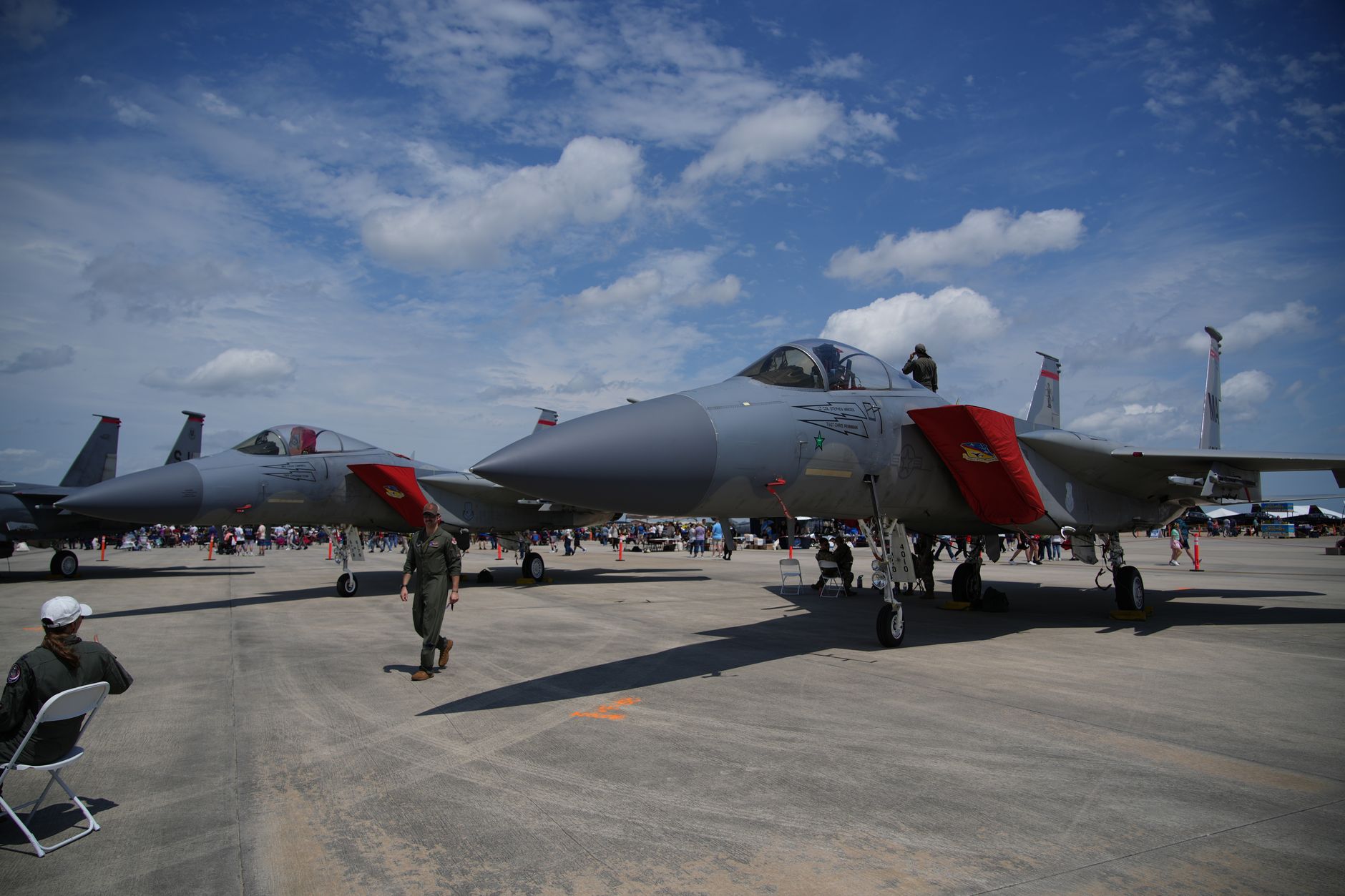
Key Takeaways
- •The F-15EX Eagle II is the most advanced F-15 variant, featuring a digital backbone and fly-by-wire flight controls for enhanced performance.
- •It integrates the cutting-edge Eagle Passive/Active Warning Survivability System (EPAWSS) for superior electronic warfare and threat detection capabilities.
- •Boasting a projected 20,000-hour airframe life and up to 22 missile stations, the F-15EX offers unparalleled payload capacity and mission longevity.
- •Designed for cost-effective integration, it provides an affordable, high-capacity air superiority and strike platform to complement 5th-generation fighters.
Technical Specifications & Data
| Primary Role | Air Superiority, Multi-role Fighter, Deep Strike |
| Airframe Life | 20,000 flight hours (extended) |
| Max Takeoff Weight (MTOW) | 81,000 lbs (36,741 kg) |
| Max Speed | Mach 2.5+ (1,650 mph; 2,660 km/h) |
| Combat Radius | 700+ miles (1,100 km) with internal fuel |
| Engines | 2 × General Electric F110-GE-129 turbofans (29,000 lbf thrust each) |
| Radar System | AN/APG-82(V)1 AESA Radar |
| Electronic Warfare Suite | Eagle Passive/Active Warning Survivability System (EPAWSS) |
| Mission Computer | Advanced Display Core Processor II (ADCP II) |
| Weapon Stations | 22 missile stations (12 A/A, 15 A/G hardpoints) |
| Flight Controls | Full Fly-By-Wire (FBW) digital system |
| Unit Cost (approx.) | $80-90 million (flyaway cost) |
Technical Architecture Overview
The Boeing F-15EX Eagle II represents the zenith of the venerable F-15 lineage, integrating a suite of advanced technologies that fundamentally transform its operational capabilities. Unlike its predecessors, the F-15EX features a revolutionary digital backbone, replacing older analog systems with a high-bandwidth, open-architecture processing environment. This digital overhaul is crucial, enabling rapid software upgrades and hardware integration, vital for adapting to evolving threats and mission requirements in modern aerial combat. At its core, the aircraft is powered by the Advanced Display Core Processor II (ADCP II), a mission computer capable of processing 87 billion instructions per second, which consolidates sensor data and enhances situational awareness for the pilot.
A monumental leap for the F-15 platform is the implementation of a full fly-by-wire (FBW) flight control system. This system, a first for any F-15 variant, replaces traditional mechanical linkages with electronic signals, offering precise control inputs, improved maneuverability, and a significant reduction in pilot workload, especially during high-G maneuvers. The cockpit itself has been completely redesigned, featuring a modern, intuitive layout centered around a large 10x19-inch area display (LAD). This display provides a comprehensive, customizable view of critical flight and tactical information, greatly enhancing the pilot's ability to manage complex engagements.
Structurally, the F-15EX benefits from a substantially improved airframe designed for a projected service life of 20,000 flight hours – more than double that of earlier F-15 C/D models. This extended lifespan significantly reduces sustainment costs over the aircraft's operational duration. The robust airframe, combined with redesigned pylons, also allows for an unprecedented weapon carriage capacity, enabling the F-15EX to serve as a 'missile truck' or a deep-strike platform. The aircraft's open architecture design ensures that future upgrades, from new sensors to advanced weaponry and artificial intelligence capabilities, can be seamlessly integrated, guaranteeing its relevance for decades to come.
Deep-Dive Systems & Performance Benchmarks
The F-15EX Eagle II's combat prowess is defined by its cutting-edge systems and robust performance metrics. Central to its survivability and offensive capabilities is the Eagle Passive/Active Warning Survivability System (EPAWSS). This integrated electronic warfare (EW) suite provides comprehensive detection, identification, and jamming capabilities against a wide spectrum of radar-guided threats. EPAWSS employs advanced algorithms and digital radio frequency memory (DRFM) jamming techniques, ensuring the aircraft can operate effectively in highly contested environments, thereby significantly reducing pilot risk. Unlike previous F-15 EW systems, EPAWSS is fully integrated, offering 360-degree threat coverage and autonomous operation.
For target detection and engagement, the F-15EX is equipped with the AN/APG-82(V)1 Active Electronically Scanned Array (AESA) radar. This radar offers superior long-range detection, high-resolution mapping, and simultaneous air-to-air and air-to-ground capabilities. Its enhanced processing power allows for tracking of numerous targets simultaneously, even in heavy jamming conditions. Coupled with the ADCP II, the APG-82(V)1 provides pilots with unparalleled situational awareness and targeting precision, enabling engagement of threats well beyond visual range.
Performance-wise, the F-15EX retains the legendary speed and agility of its predecessors, capable of exceeding Mach 2.5+ at high altitude and enduring maneuvers up to +9.0 Gs. It is powered by two formidable General Electric F110-GE-129 turbofan engines, each producing approximately 29,000 pounds of thrust with afterburner, providing an exceptional thrust-to-weight ratio. The aircraft's operational ceiling is above 60,000 feet, allowing it to dominate the high-altitude battlespace. Most impressively, the F-15EX boasts 12 air-to-air weapon stations and 15 air-to-ground stations, allowing it to carry up to 22 air-to-air missiles (e.g., AMRAAM, Sidewinder) or an immense load of precision-guided munitions like Joint Direct Attack Munitions (JDAMs) and Small Diameter Bombs (SDBs). This payload capacity makes it the heaviest-carrying tactical fighter in the U.S. inventory, capable of delivering immense firepower in a single sortie.
Why This Matters & Industry Impact
The introduction of the F-15EX Eagle II has significant implications for airpower strategy and the defense industrial base. For the United States Air Force (USAF), the F-15EX serves a critical role in modernizing its aging F-15C/D fleet, many of which are nearing the end of their service lives. Rather than a direct replacement for 5th-generation fighters like the F-35 or F-22, the Eagle II is designed to complement them, providing a cost-effective, high-capacity platform for air superiority and deep-strike missions. Its ability to carry a vast array of weapons makes it an invaluable 'missile truck' that can significantly augment the F-35's stealth capabilities by carrying additional ordnance.
Economically, the F-15EX program represents a strategic investment. Its commonality with existing F-15 infrastructure means lower acquisition costs and faster integration into the fleet compared to developing an entirely new platform. Furthermore, the extended airframe life and modern systems are projected to result in lower long-term sustainment costs, making it an attractive option for budget-conscious defense planners. This approach ensures the USAF can maintain air superiority and strike capabilities without solely relying on expensive 5th-generation assets for all missions, optimizing its force structure.
Beyond the USAF, the F-15EX has substantial export potential. Nations seeking a potent, combat-proven 4.5 generation fighter with advanced capabilities, without the higher operational costs or security restrictions often associated with 5th-generation aircraft, are prime candidates. Countries like India, Saudi Arabia, and other allies could significantly bolster their air forces with the Eagle II's advanced features, especially its robust EW capabilities and immense payload. The F-15EX also reinforces the concept of 'digital superiority', where rapid software and hardware upgrades become as critical as raw performance metrics, influencing future fighter jet development and procurement strategies across the globe. It underscores a pivot towards highly adaptable, network-centric platforms capable of integrating into concepts like the Advanced Battle Management System (ABMS), ensuring its relevance in future multi-domain operations.
Explore advanced aerospace engineering courses to understand modern fighter jet design and avionics.
Chronological Timeline
USAF officially designates the F-15EX program and announces plans to acquire the aircraft.
First flight of the F-15EX (designated EX1) prototype at St. Louis, Missouri.
First two F-15EX aircraft (EX1 and EX2) are delivered to the USAF at Eglin Air Force Base, Florida.
F-15EX participates in its first operational exercise, 'Northern Edge 21', demonstrating interoperability.
Projected Initial Operational Capability (IOC) with the full complement of planned systems and capabilities.
Frequently Asked Questions
What is the primary role of the F-15EX Eagle II?
How does the F-15EX differ from older F-15 variants?
Why did the USAF choose the F-15EX over more 5th-generation fighters?
What is EPAWSS?
Daily Specs Editorial Staff
Lead Technical Analyst & Hardware Researcher
The Daily Specs editorial staff compiles, benchmarks, and verifies emerging technical specifications directly from system architecture manuals, hardware datasheets, and open-source codebases to deliver high-gain technical intelligence.